 简体中文
简体中文  English
  日本語
日本語  한국어
한국어  Français
  Deutsch
  Español
  Português
  Русский
  العربية
  ไทย
ไทย  Tiếng Việt

产品概述
Universal Untied Expansion Joint
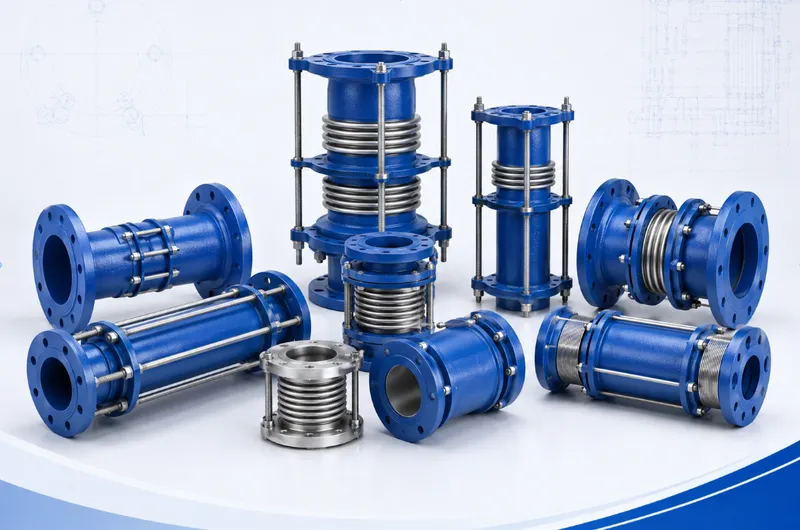
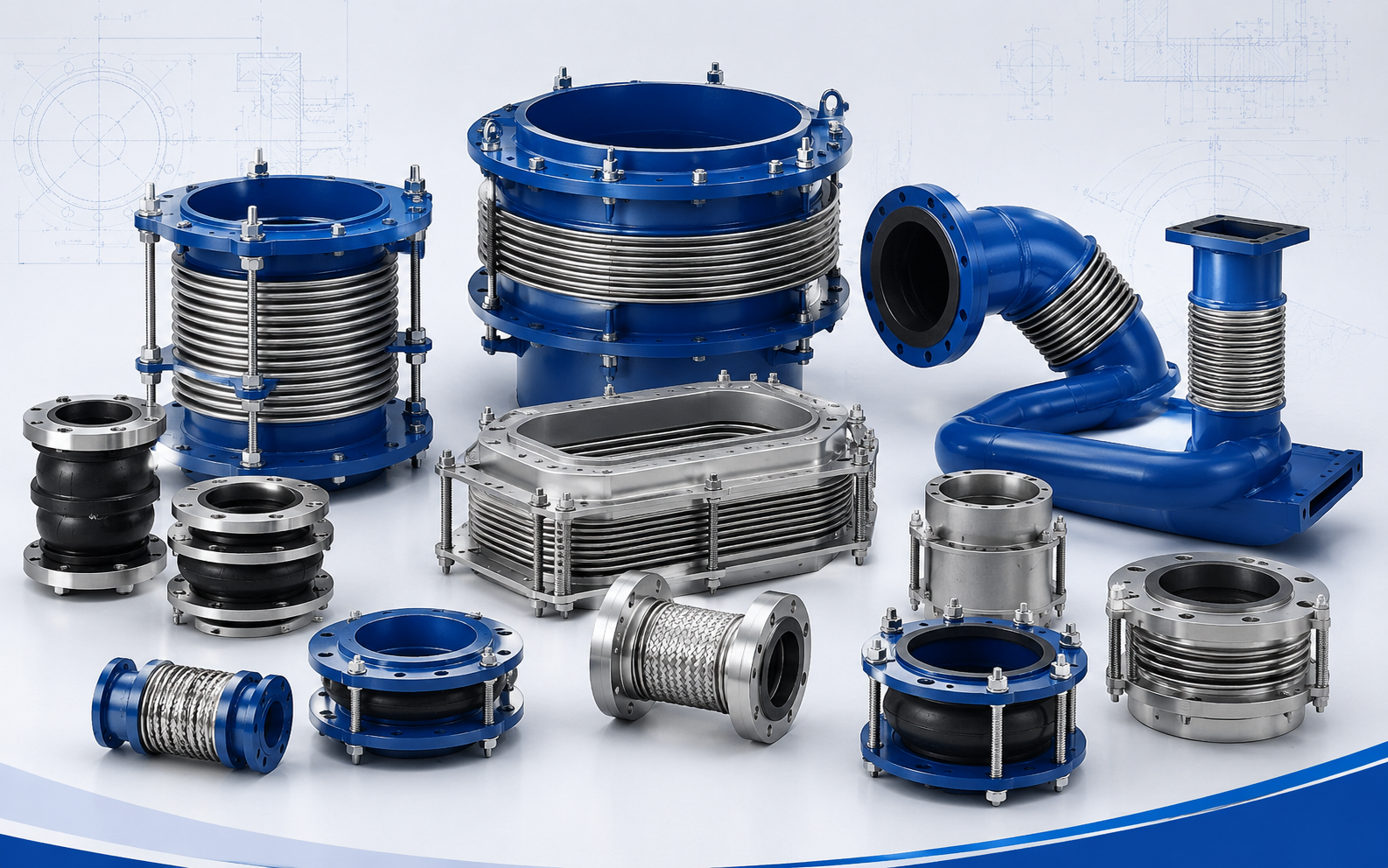
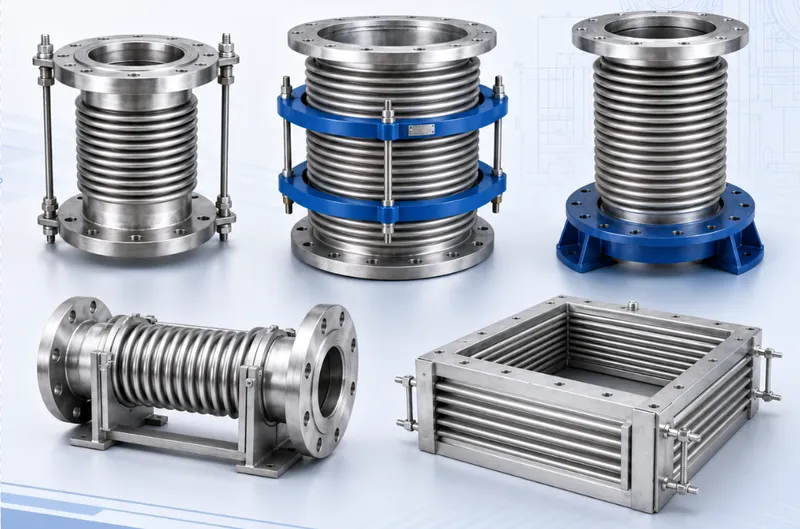
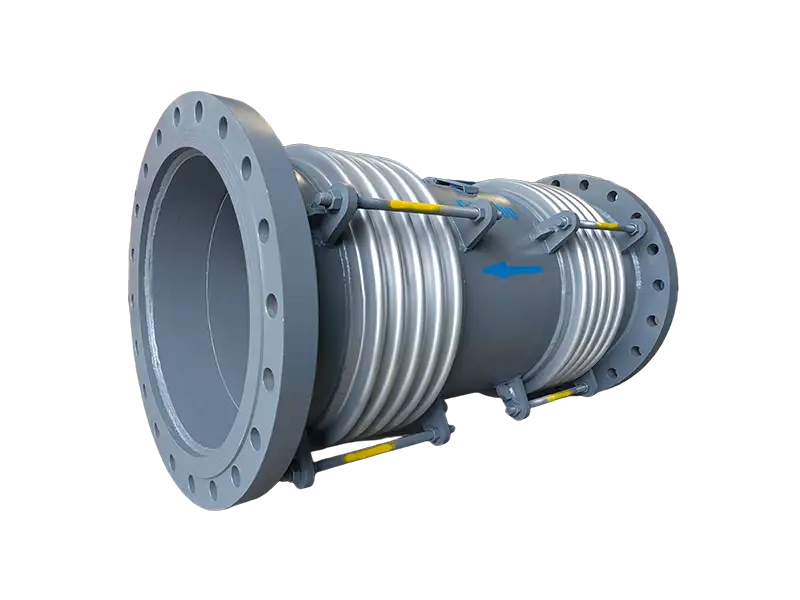
A universal untied expansion joint combines two metal bellows with a center spool to provide more movement flexibility than a single-bellows assembly.
It can distribute axial movement between the two bellows and develop lateral movement through angular rotation at both flexible elements.
What “Untied” Means
Untied does not mean that the expansion joint can move without piping-system control.
It means that the assembly does not contain permanent structural hardware designed to continuously restrain the full bellows pressure thrust.
Pressure acting on the effective bellows area therefore generates an axial force that normally has to be resisted by the piping main anchors.
Sharing Axial Movement
When the connected piping expands or contracts along its centerline, both bellows can participate in the axial movement.
The movement share depends on the axial spring rate of each bellows, the center-spool arrangement and the piping boundary conditions.
The available axial travel must be evaluated together with any simultaneous lateral displacement.
Developing Lateral Movement
Lateral displacement is produced when the two bellows rotate in opposite angular directions and the center spool translates relative to the connection ends.
This geometric movement normally provides more lateral travel than attempting to deflect a single bellows directly sideways.
A longer center spool can increase lateral movement for a given bellows rotation, but also increases overall length, dead weight and required installation space.
Combined Movement Capacity
Axial and lateral movements use the same bellows flexibility.
Maximum axial travel and maximum lateral travel cannot normally be applied simultaneously without a combined movement evaluation.
Required movement should be based on the actual operating sequence and piping displacement path.
Control Rods Are Not Always Tie Rods
Selected universal untied joints include control rods, limit rods or movement-distribution linkages.
These components can stabilize the center spool and help distribute movement between the two bellows.
Short rods installed across an individual bellows section should not automatically be treated as full-thrust tie rods.
Their load capacity and operating function must be confirmed from the approved structural drawing.
Difference from a Tied Universal Joint
Both products contain two bellows separated by a center spool and can accommodate lateral movement.
The untied universal design can also participate in axial movement, but transfers bellows pressure thrust to the external anchor system.
A tied universal expansion joint uses permanent full-thrust tie rods to restrain its overall length and contain pressure thrust.
The tied design is therefore normally intended mainly for lateral movement rather than unrestricted axial travel.
Where This Design Fits
- Piping with combined axial and lateral thermal movement
- L-shaped, Z-shaped or elevation-changing pipe layouts
- Equipment connections subject to relative displacement
- Steam, hot-water and circulation piping
- Power, petrochemical and metallurgical process systems
- Pipelines with properly designed pressure-thrust anchors
When Another Design May Be Better
A standard universal untied expansion joint may not be suitable where a pressure-thrust-resistant main anchor cannot be installed.
Systems with limited equipment-nozzle loads, higher pressure or restricted structural anchoring may require a tied, hinged, gimbal or pressure-balanced arrangement.
The joint should not be used to absorb uncontrolled torsion or excessive construction misalignment.
Center-Spool Engineering
The center spool establishes the distance between the two flexible rotation centers.
Its length affects lateral movement, bellows rotation, assembly weight and the available installation envelope.
It should not be shortened, extended or replaced at site without engineering approval.
Flow Liner Arrangement
High-velocity, turbulent or particle-laden service may require an internal flow liner.
Because axial and lateral movements may occur in the same assembly, the liner requires sufficient overlap and radial operating clearance.
Bidirectional flow, reverse purging and solids accumulation should be identified before design.
Cold Preset
Where lateral thermal movement occurs primarily in one direction, the assembly can be supplied with a calculated cold preset.
Correct preset allows the available movement to be used more effectively between cold and operating positions.
Preset direction and amount must follow the piping movement analysis and approved manufacturing drawing.
Anchor and Guide Strategy
Main anchors define the compensated pipe section and resist pressure thrust together with other axial system loads.
Guides control the piping movement path and reduce the risk of instability, uncontrolled displacement and torsional loading.
Pipe, valve, insulation and process-medium weight should be carried by independent supports.
Installation Verification
- Confirm orientation, flow direction and cold length
- Verify axial and lateral movement directions
- Confirm that the main anchors are structurally complete
- Ensure guides do not block the specified lateral movement
- Check the approved cold preset direction and amount
- Do not use the joint to pull misaligned piping together
- Do not twist the assembly to align flange holes
- Do not remove control or limiting components without approval
- Protect bellows and control hardware during site welding
In-Service Movement Check
Both bellows should share movement in the manner anticipated by the design.
Movement concentrated at one bellows, excessive center-spool tilt, sagging or torsion may indicate incorrect support, preset or control-rod adjustment.
Inspection should also consider localized bellows distortion, bent control rods, liner contact, weld leakage and abnormal support movement.
Engineering Data Required
- Complete piping layout and proposed installation location
- Required axial compression and extension
- Required lateral movement, direction and movement plane
- Whether axial and lateral movements occur simultaneously
- Pipe size, wall thickness and end connections
- Design, operating and test pressure
- Design, operating and installation temperatures
- Process medium, flow direction, velocity and corrosion conditions
- Main-anchor, guide and load-bearing support arrangement
- Available face-to-face length and lateral clearance
- Material, cycle-life and inspection requirements
Final construction, control-rod function, center-spool length, combined axial and lateral movement, bellows spring forces and anchor loads are subject to the approved technical specification, design calculations and manufacturing drawing.
常见问题
What movement does Double-acting Free-expansion Joint compensate?⌄
What is the purpose of a pressure-balanced design?⌄
How is bellows material selected?⌄
Are guides and anchors required?⌄
What information is needed for a quotation?⌄
Can this product be customized by project drawing?⌄
What inspections are made before shipment?⌄
How are packing and export documents confirmed?⌄
Need the Right Double-acting Free-expansion Joint for Your Project?
Get professional solutions and competitive quotes from our engineering team.