 简体中文
简体中文  English
  日本語
日本語  한국어
한국어  Français
  Deutsch
  Español
  Português
  Русский
  العربية
  ไทย
ไทย  Tiếng Việt

产品概述
High-Temperature Flue Gas Expansion Joint Overview
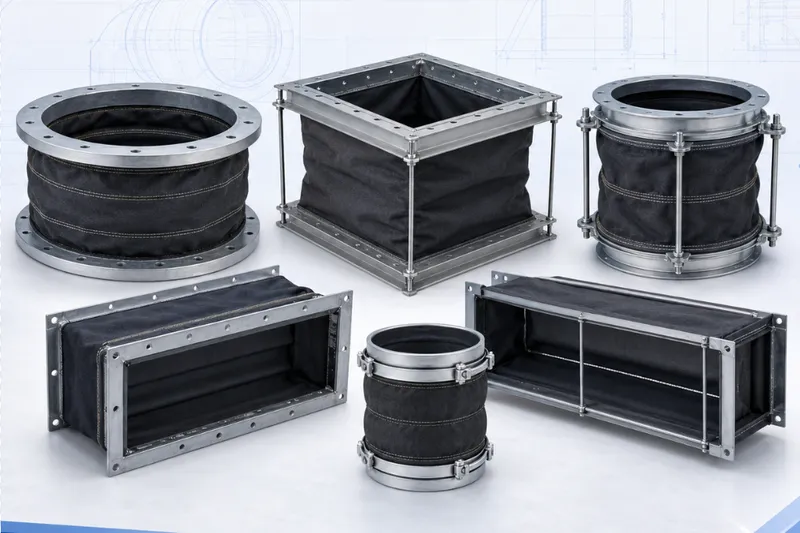
A high-temperature flue gas expansion joint is a non-metallic flexible compensator designed for boiler ducts, hot-air systems, SCR units, flue-gas treatment equipment, dust-collection lines and metallurgical gas ducting.
Its multilayer flexible element accommodates movement caused by thermal expansion, equipment vibration and installation variation. Depending on the engineered construction, the joint can absorb axial, lateral, angular and selected combined movements.
For high-temperature, high-velocity, dusty or abrasive service, an internal flow liner and insulation arrangement can be incorporated to reduce direct exposure of the outer sealing layers to hot gas and solid particles.
Key Features
- Designed for high-temperature flue gas and hot-air ducting
- Accommodates axial, lateral, angular and combined movement
- Requires relatively short installation length
- Helps isolate vibration generated by fans and equipment
- Reduces thermal movement loads transferred to adjoining ductwork
- Optional internal flow liner and thermal-insulation arrangement
- Available for round, rectangular and custom duct openings
- Material construction can be selected for heat, corrosion and abrasion
- Available as a complete framed assembly or project-specific flexible belt
Construction
A high-temperature flue gas expansion joint generally consists of metal connection frames, a non-metallic flexible belt, a gas-sealing barrier, reinforcement layers, thermal-insulation layers, compressible insulation, clamping bars and an internal flow liner.
The metal frames connect the joint to the ductwork or equipment. The flexible belt accommodates movement and maintains the system seal. Reinforcement layers improve dimensional stability, while thermal barriers reduce the temperature reaching the outer flexible sealing materials.
The internal flow liner improves the flow path and helps protect the flexible element and insulation from high-velocity gas, dust and abrasive particles.
Multilayer Flexible Construction
High-temperature flue gas expansion joints commonly use a multilayer construction in which individual layers perform heat-resistance, sealing, reinforcement, insulation and external-protection functions.
Depending on project requirements, the flexible element may incorporate high-temperature fabrics, glass-fibre reinforcement, coated fabric layers, fluoropolymer barriers and other engineered non-metallic materials.
The actual layer arrangement should be selected according to gas temperature, chemical composition, moisture, pressure conditions, required movement and design service life.
Thermal Protection and Flow Liner
Where the gas temperature exceeds the suitable continuous-use condition of the external sealing layer, internal insulation and a flow liner can be used to reduce the temperature reaching the flexible belt.
For high-velocity or particle-laden gas, the flow liner helps reduce direct impingement and abrasion on the flexible construction.
In applications subject to dust accumulation, a compressible insulation pillow or accumulation-control arrangement may be evaluated according to the duct orientation and operating conditions.
Material Selection
Flexible materials should be selected according to operating temperature, gas composition, corrosion, moisture, oxygen content, pressure or vacuum, gas velocity and dust abrasion.
Metal frames, clamping bars and flow liners can be manufactured from carbon steel, stainless steel, heat-resistant steel or other specified materials according to the project conditions.
If the gas temperature may fall below the dew point, material selection should also consider acidic condensate and wet flue-gas corrosion rather than only the maximum temperature.
Movement Capability
The flexible element can be engineered to accommodate axial compression, axial extension, lateral movement, angular deflection and selected combinations of these movements.
Actual allowable movement depends on joint dimensions, installed length, flexible-element profile, layer construction, operating temperature, pressure conditions and required cycle life.
The expansion joint should not support the weight of ductwork, equipment or insulation. Suitable anchors, guides and load-bearing structures remain necessary.
Suitable Service
This product is primarily intended for hot air, flue gas, industrial exhaust and selected corrosive process gases in relatively low-pressure or negative-pressure ducting systems.
Wet flue gas, acidic gas, severe corrosion, heavy dust loading, abnormal temperature excursions and pulsating pressure require project-specific material and structural evaluation.
It should not be selected as a conventional pressurized-liquid pipe joint, and rubber-joint pressure classes or hydrostatic test assumptions should not be applied without engineering confirmation.
Typical Applications
- Power-plant boiler flue-gas ducting
- SCR reactor inlet and outlet ducts
- Flue-gas desulfurization and treatment systems
- Industrial furnaces and high-temperature hot-air ducts
- Fan inlet and outlet connections
- Dust-collection and particle-laden gas systems
- Cement, steel, metallurgical and chemical plants
- Gas-turbine and heat-recovery exhaust systems
Installation Guidelines
- Confirm the gas-flow direction and product orientation
- Arrange the flow-liner overlap to suit the direction of flow
- Verify duct dimensions, installed length and preset movement
- Keep connection frames aligned and avoid twisting the flexible belt
- Do not stretch or compress the joint to correct duct misalignment
- Protect flexible materials from welding sparks and sharp objects
- Protect insulation and flexible layers during site welding
- Do not use the joint to support ductwork or equipment weight
- Inspect the liner, flexible belt, clamps and sealing areas before operation
Operation and Maintenance
The flexible belt, metal frames, clamping components, internal flow liner, insulation and adjacent supports should be inspected periodically.
Inspection intervals should reflect the actual gas temperature, corrosion, dust loading, vacuum, vibration and frequency of operating-temperature changes.
Discoloration, hardening, cracking, abrasion, leakage, excessive deformation or localized overheating should prompt a review of the actual temperature, liner condition, insulation, system movement and duct support arrangement.
Information Required for Quotation
Please provide the following information so that the flexible layers, insulation, flow liner and metal frames can be properly evaluated:
- Round diameter or rectangular duct dimensions
- Installed length and available installation space
- Normal, maximum and excursion gas temperatures
- Ambient temperature and external surface-temperature requirements
- Operating pressure, vacuum and pressure fluctuations
- Gas composition, corrosion, moisture and dew-point conditions
- Gas velocity, dust loading and particle abrasion
- Required axial, lateral, angular and combined movement
- Flange, frame, drilling or welded-connection requirements
- Flow-liner, insulation and accumulation-control requirements
- Installation position, quantity, packaging and destination port
We can review and customize high-temperature flue gas expansion joints according to operating conditions, duct dimensions, site sketches and project drawings. Final materials, dimensions, movement capacity and inspection requirements are subject to the approved technical specification and manufacturing drawing.
常见问题
Which working conditions is High-Temperature Flue Gas Expansion Joint suitable for?⌄
What layers are used in a non-metallic expansion joint?⌄
Is a liner or flow sleeve required?⌄
Can non-standard sizes be supplied?⌄
What information is needed for a quotation?⌄
Can this product be customized by project drawing?⌄
What inspections are made before shipment?⌄
How are packing and export documents confirmed?⌄
Need the Right High-Temperature Flue Gas Expansion Joint for Your Project?
Get professional solutions and competitive quotes from our engineering team.