 简体中文
简体中文  English
  日本語
日本語  한국어
한국어  Français
  Deutsch
  Español
  Português
  Русский
  العربية
  ไทย
ไทย  Tiếng Việt


产品概述
In-Line Pressure-Balanced Expansion Joint Overview
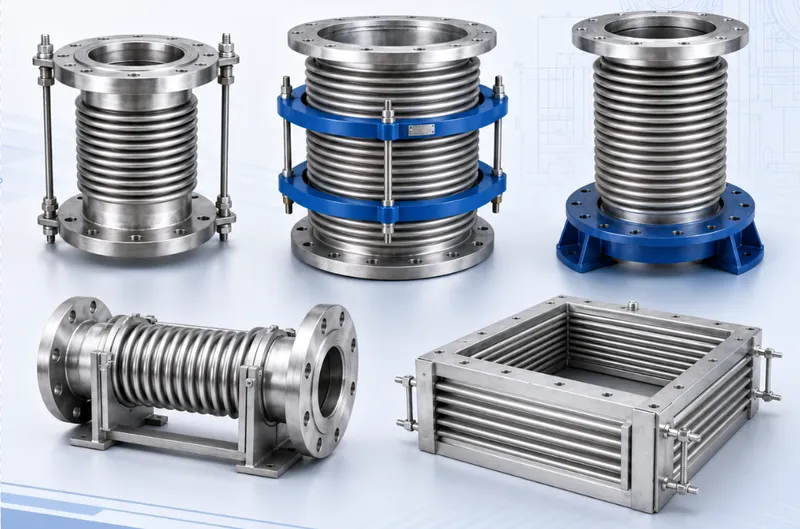
A straight-pipe pressure-balanced expansion joint, also commonly described as an in-line pressure-balanced expansion joint, is a metal bellows assembly designed for installation in a straight piping run.
The working bellows accommodates axial thermal movement, while a balancing bellows or annular pressure chamber creates an opposing pressure force within the assembly. Tie rods and structural components contain and transfer the pressure-related loads internally.
This arrangement reduces the pressure thrust transmitted to external main anchors and equipment nozzles. It is particularly useful where anchor capacity is limited, where a conventional pressure-thrust-resistant anchor is impractical, or where connected equipment has a restricted allowable nozzle load.
Key Features
- Primarily accommodates axial compression and extension
- Reduces pressure thrust transmitted to external anchors
- Helps limit pressure-related loads on equipment nozzles
- Suitable for straight piping runs
- Useful where a large main anchor is impractical
- Available with welded or flanged connection ends
- Optional flow liner, external cover and shipping restraints
- Custom design based on pressure, temperature and movement
Construction
An in-line pressure-balanced expansion joint generally consists of one or more working bellows, a balancing bellows or oversized balancing element, intermediate piping, pipe ends or flanges, tie rods, structural plates, an optional internal flow liner, an external cover and any required guiding or shipping-restraint components.
The working bellows accommodates the pipeline movement. The balancing bellows or pressure chamber generates a pressure force opposing the thrust produced at the working end of the assembly.
Tie rods and structural plates connect the bellows elements and transfer the pressure-related loads within the expansion joint. The detailed bellows arrangement, effective areas and tie-rod configuration depend on the approved design.
Operating Principle
As the connected pipeline expands or contracts, the working bellows compresses or extends along the pipe axis. This movement accommodates the thermal displacement of the adjoining straight pipe run.
Internal pressure acts on the effective areas of both the working and balancing elements. By selecting the appropriate balancing area and internal load-transfer arrangement, opposing pressure forces are created within the assembly.
The pressure-balanced construction reduces the net pressure thrust imposed on the external piping system. It does not eliminate the spring force generated by bellows movement or other piping-system loads.
Movement Capability
A straight-pipe pressure-balanced expansion joint is normally designed primarily for axial compression and axial extension.
It should not be assumed to accommodate significant lateral movement, angular rotation or torsion unless the complete assembly has been specifically designed and approved for those movements.
Where substantial lateral movement is present, a pressure-balanced universal arrangement, pressure-balanced elbow design or another engineered configuration may be more appropriate.
Required axial movement should be calculated from pipe length, installation temperature, maximum and minimum operating temperatures, pipe material and piping-system geometry.
Pressure-Balancing Function
A conventional unrestrained axial expansion joint generates pressure thrust when internal pressure acts on the effective area of the bellows. That thrust normally has to be resisted by main anchors.
An in-line pressure-balanced design uses an additional bellows, annular pressure chamber and internal tie-rod arrangement to contain most of this pressure thrust within the assembly.
This can substantially reduce the pressure-thrust requirement imposed on external anchors and connected equipment. Pressure balanced does not mean that the complete piping system is free from all loads.
Anchors, Guides and Supports
Appropriate intermediate anchors, pipe guides and load-bearing supports remain necessary to maintain the intended pipeline geometry and direct movement along the expansion-joint axis.
The piping design must still account for bellows spring force, pipe and medium weight, support friction, dynamic flow loads, wind, seismic effects and other project-specific forces.
When the expansion joint is installed near pumps, compressors, heat exchangers or other equipment, the equipment manufacturer's allowable nozzle loads should be considered together with the piping stress analysis.
Bellows and Material Selection
Working and balancing bellows can be manufactured from project-confirmed stainless steels or corrosion-resistant alloys according to medium compatibility, temperature, pressure and required fatigue life.
Pipe ends, flanges, intermediate piping, tie rods, structural plates and protective components can be manufactured from carbon steel, stainless steel, alloy steel or another specified material.
Bellows materials, effective areas, convolution geometry, number of plies and spring rates must be coordinated as part of the complete pressure-balanced design.
Flow Liner and External Protection
An internal flow liner may be specified for high-velocity, turbulent or particle-laden media, or where the joint is installed near elbows, valves and other flow-disturbing components.
The flow liner helps provide a smoother flow path and protects the bellows from direct erosion and selected flow-induced vibration.
An external cover can protect the bellows from transport impact, welding spatter and mechanical damage at the installation site. Protective components must not restrict the designed movement.
Typical Applications
- Industrial steam and high-temperature hot-water piping
- District-heating and thermal transmission systems
- Petrochemical and chemical process piping
- Power-generation, metallurgical and energy projects
- Piping adjacent to pumps, compressors and rotating equipment
- Heat-exchanger, vessel and process-equipment connections
- Straight pipe runs with limited main-anchor capacity
- Projects requiring reduced pressure load on equipment nozzles
Installation Guidelines
- Confirm flow direction, orientation and installation position
- Verify installed length, preset position and axial travel
- Maintain proper alignment of the connected piping
- Do not force the joint into position to correct piping errors
- Do not subject the bellows to unapproved torsional loading
- Provide anchors, guides and supports required by the piping design
- Protect the bellows and tie-rod assembly during site welding
- Do not remove permanent tie rods or structural components
- Remove or adjust shipping restraints only as instructed
- Inspect liners, rods, welds and movement clearance before operation
Operation and Inspection
Bellows, tie rods, structural plates, connection welds, anchors and guides should be inspected according to the medium, pressure, temperature, movement cycles and project maintenance plan.
Bellows distortion, bent tie rods, assembly misalignment, leakage, cover contact or excessive travel should prompt a review of actual pipeline movement, pressure, supports and installation conditions.
Quality and Inspection Options
Typical production checks can include material verification, visual inspection, critical dimensional inspection, bellows and connection-area inspection, tie-rod assembly inspection, weld inspection and final packaging inspection.
Pressure testing, leak testing, nondestructive examination, material certificates, dimensional reports or other project inspections can be agreed according to the purchase specification.
Information Required for Quotation
Please provide the following information so that the working bellows, balancing arrangement and connection design can be properly evaluated:
- Nominal diameter or pipe outside diameter and wall thickness
- Design pressure and operating pressure
- Design, operating and installation temperatures
- Process medium and corrosion requirements
- Required axial compression and axial extension
- Required operating cycles or design fatigue life
- Face-to-face length and available installation space
- Weld-end dimensions, flange standard or other connections
- Equipment allowable nozzle loads or anchor limitations
- Pipeline anchor, guide and support arrangement
- Flow velocity and internal flow-liner requirements
- Material, inspection, packaging and quantity requirements
We can review and customize in-line pressure-balanced expansion joints according to pressure, temperature, medium, axial movement, equipment-load limitations, piping layout and project drawings.
Final construction, materials, pressure rating, movement capacity, pressure-balancing performance, connection loads and inspection requirements are subject to the approved technical specification and manufacturing drawing.
常见问题
What movement does Straight-pipe Pressure-balanced Expansion Joint compensate?⌄
What is the purpose of a pressure-balanced design?⌄
How is bellows material selected?⌄
Are guides and anchors required?⌄
What information is needed for a quotation?⌄
Can this product be customized by project drawing?⌄
What inspections are made before shipment?⌄
How are packing and export documents confirmed?⌄
Need the Right Straight-pipe Pressure-balanced Expansion Joint for Your Project?
Get professional solutions and competitive quotes from our engineering team.