 简体中文
简体中文  English
  日本語
日本語  한국어
한국어  Français
  Deutsch
  Español
  Português
  Русский
  العربية
  ไทย
ไทย  Tiếng Việt

产品概述
Externally Pressurized Axial Expansion Joint
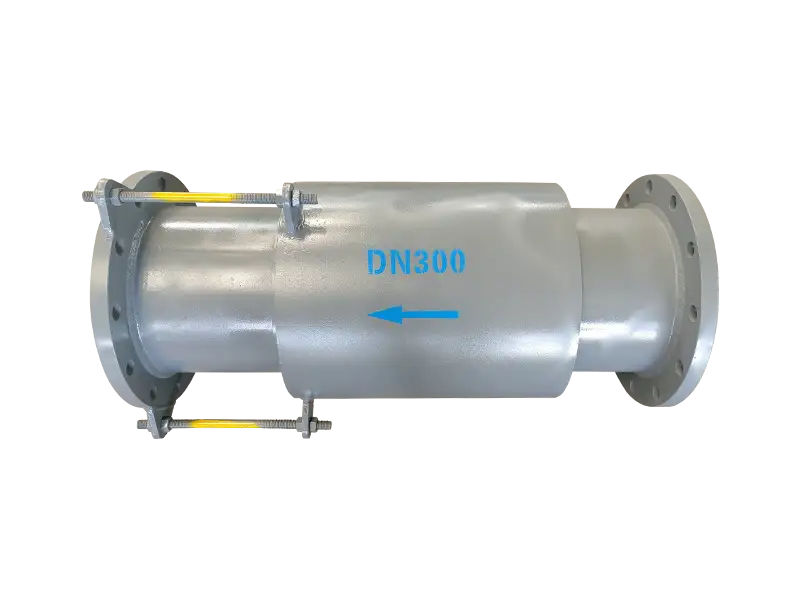
An externally pressurized axial expansion joint is a metal bellows assembly designed to accommodate axial thermal movement in straight piping runs.
An internal flow path directs the process medium into an annular pressure chamber surrounding the bellows, so pressure acts on the outside surface of the bellows.
As the connected piping expands or contracts, the bellows compresses or extends along the pipeline centerline, accommodating the calculated axial movement.
The externally pressurized arrangement supports axial stability and can be engineered for relatively large axial movement requirements.
Key Features
- Primarily accommodates axial compression and extension
- Process pressure acts on the outside surface of the bellows
- Supports improved axial stability of longer bellows elements
- Suitable for relatively large axial movement requirements
- Outer casing provides mechanical protection for the bellows
- Optional internal guides and movement-limiting components
- Available with welded, flanged or custom connection ends
- Custom design based on medium, pressure, temperature and cycle life
Construction
An externally pressurized axial expansion joint generally consists of a metal bellows, an outer casing, an internal flow or line pipe, pipe ends, flanges or weld ends, guide rings, end rings and any required shipping restraints, vent or drain connections.
The metal bellows is the primary flexible element for accommodating axial movement. The outer casing and internal pipe form the process-flow path and external pressure chamber.
Guide rings can be incorporated to maintain the intended relationship between the internal pipe, outer casing and bellows as the assembly moves axially.
The outer casing also provides selected mechanical protection against handling damage, welding spatter and impact at the installation site.
Internal flow, guiding, venting and drainage arrangements may differ by design. Final construction should follow the approved sectional and manufacturing drawings.
Operating Principle
The process medium enters an annular pressure chamber around the outside of the metal bellows through the internal flow arrangement.
When the connected pipeline heats up, the pipe section expands axially and the bellows compresses within its engineered movement range.
When the pipeline cools, the bellows extends in the opposite direction, accommodating contraction of the pipe section.
The bellows flexes through its convolution geometry without relying on a sliding packing seal. Actual movement capacity depends on bellows material, convolution profile, number of convolutions, number of plies, pressure, temperature and required fatigue life.
Externally Pressurized Design
Internally pressurized bellows can be subject to radial expansion and axial column instability, particularly where a long bellows element or large axial movement is required.
Applying process pressure to the outside of the bellows supports axial stability and provides additional design flexibility for a greater number of convolutions and relatively large axial movement.
External pressurization does not provide unlimited movement capacity. The design must still account for pressure, temperature, bellows stability, axial spring rate and required operating cycles.
Movement Direction
An externally pressurized axial expansion joint is primarily designed for movement along the pipeline centerline.
It should not be described as simultaneously accommodating large axial, lateral and angular movement in a conventional configuration.
Minor installation tolerance is not equivalent to an engineered lateral or angular movement capacity. The joint should also not be subjected to torsional loading.
Piping systems with significant lateral, angular or combined movement may require a universal, hinged, gimbal or another specially engineered arrangement.
Pressure Thrust
A conventional externally pressurized axial expansion joint is normally not a pressure-balanced expansion joint. External pressurization changes the way pressure acts on the bellows, but it does not automatically eliminate pressure thrust.
Process pressure acting on the effective area of the bellows still generates an axial force that normally has to be resisted by the main anchors.
Main-anchor loads should also include bellows axial spring force, pipe and medium weight, support friction and other system loads.
Where a pressure-thrust-resistant main anchor cannot be installed, or where equipment nozzle loads are limited, a pressure-balanced or otherwise restrained expansion-joint arrangement should be evaluated.
Anchors, Guides and Supports
An externally pressurized axial expansion joint should be installed in a straight piping section with defined main anchors and a suitable guide arrangement.
Main anchors define the compensated pipe section and resist pressure thrust, bellows spring force and other axial system loads.
Pipe guides maintain alignment and direct thermal movement into the bellows along the intended axis.
Correct guiding reduces the risk of pipe misalignment, lateral instability, bellows side loading and movement beyond the designed range.
Pipe, valves, insulation and process-medium weight should be carried by independent supports and should not be supported by the expansion joint.
Material Selection
Bellows material should be selected according to process-medium compatibility, operating temperature, design pressure, corrosion conditions and required fatigue life.
Project-confirmed stainless steels, corrosion-resistant alloys or other suitable bellows materials can be specified.
The outer casing, internal pipe, pipe ends, flanges, guide rings and structural components can be manufactured from carbon steel, stainless steel, alloy steel or other specified materials.
Final material combinations should be reviewed for corrosion resistance, operating environment, welding procedures and expected service life.
Guiding, Venting and Drainage
Selected externally pressurized designs incorporate internal guide rings to maintain the intended movement between the internal pipe, outer casing and bellows.
Steam, hot-water, thermal-fluid and condensing-service applications should be evaluated for venting and drainage requirements.
Vent, drain and monitoring connections should be positioned and used according to the approved internal design. Unapproved drilling, plugging or modification should be avoided.
Difference from an Internally Pressurized Axial Joint
In an internally pressurized axial joint, process pressure acts mainly on the inside surface of the bellows. This arrangement generally provides a simple and compact radial construction.
An externally pressurized axial joint directs the process medium to the outside of the bellows, supporting stability where more convolutions or greater axial movement are required.
Both designs require evaluation of pressure, temperature, movement, stability, installation space and piping support conditions.
An externally pressurized design should not be confused with a pressure-balanced expansion joint.
Typical Applications
- District-heating and regional thermal networks
- Industrial steam and high-temperature hot-water piping
- Cooling-water and circulation-water systems
- Power-generation, energy and boiler auxiliary piping
- Petrochemical and chemical process pipelines
- Metallurgical, steel and industrial circulation systems
- Straight piping runs requiring large axial movement
- Installations requiring mechanical protection of the bellows
Installation Guidelines
- Confirm product orientation, flow direction and installation position
- Verify installed length, preset position and available axial travel
- Maintain proper alignment of connected piping
- Do not stretch or compress the joint to correct pipe-length errors
- Do not apply unapproved lateral or angular movement
- Do not subject the metal bellows to torsional loading
- Do not use the joint to support pipe or equipment weight
- Install main anchors, guides and supports according to the piping design
- Protect the outer casing and internal bellows during site welding
- Remove or adjust shipping restraints only as instructed
- Confirm the correct orientation of vent and drain connections
- Inspect welds, supports and axial movement clearance before operation
Operation and Maintenance
The outer casing, connection welds, vent and drain connections, main anchors and pipe guides should be inspected according to the operating conditions and maintenance plan.
Because the bellows is enclosed within the outer casing, routine inspection should focus on leakage, casing deformation, abnormal movement, vibration, operating noise and the condition of adjoining supports.
Leakage, casing interference, assembly misalignment, unusual vibration or movement beyond the designed range should prompt a review of actual pressure, temperature, pipe alignment, anchors and guides.
Quality and Inspection Options
Typical production checks can include material verification, visual inspection, critical dimensional checks, bellows inspection, casing inspection, internal-component inspection, weld-area inspection and packaging inspection.
Pressure testing, leak testing, nondestructive examination, material certificates, dimensional reports, cleaning and other project-specific inspections can be agreed according to the purchase specification.
Test methods, test pressure, acceptance criteria and documentation requirements should be confirmed during technical and order review.
Information Required for Quotation
- Nominal diameter or pipe outside diameter and wall thickness
- Design pressure, operating pressure and testing requirements
- Design, operating and installation temperatures
- Process medium, physical state and corrosion requirements
- Required axial compression and axial extension
- Required operating cycles or design fatigue life
- Face-to-face length and available radial installation space
- Weld-end, flange or other connection requirements
- Pipeline anchor, guide and support arrangement
- Vent, drain or monitoring-connection requirements
- Bellows and structural-component material requirements
- Inspection, cleaning, packaging and quantity requirements
We can review and customize externally pressurized axial expansion joints according to pressure, temperature, process medium, axial movement, installation space, support arrangement and project drawings.
Final construction, materials, pressure rating, movement capacity, axial spring rate, fatigue life and inspection requirements are subject to the approved technical specification and manufacturing drawing.
常见问题
What movement does External-pressure axial expansion joint compensate?⌄
What is the purpose of a pressure-balanced design?⌄
How is bellows material selected?⌄
Are guides and anchors required?⌄
What information is needed for a quotation?⌄
Can this product be customized by project drawing?⌄
What inspections are made before shipment?⌄
How are packing and export documents confirmed?⌄
Need the Right External-pressure axial expansion joint for Your Project?
Get professional solutions and competitive quotes from our engineering team.